

In today's business environment, characterized by digital transformation, the constant growth of information, and evolving legal obligations, document management and regulatory compliance represent two fundamental aspects for organizations. Properly managing documents does not simply mean storing files or reducing paper consumption; it involves establishing procedures that allow information to be controlled throughout its life cycle, ensuring its availability and protecting it against loss, deterioration, unauthorized access, or improper disposal.
Both organizations that maintain large volumes of physical documents and those that work primarily with electronic information need to implement mechanisms to properly organize, retrieve, protect, preserve, and dispose of their records. In Colombia, Law 594 of 2000 – General Archives Law establishes the general rules and principles governing the archival function of the State and recognizes the importance of archives as tools for administration, decision-making, and access to information.
For this reason, document management and regulatory compliance should be understood as closely interconnected processes. An organization that knows which documents it produces, where they are located, how long they must be retained, who is authorized to access them, and what their final disposition should be is better equipped to respond to audits, legal requirements, and internal needs.
What Is Document Management and How Is It Related to Regulatory Compliance?
Document management encompasses the set of activities aimed at managing an organization's documents in an organized manner, including those it produces, receives, and uses as a result of its operations. This process involves several stages, from document creation or receipt to organization, retrieval, preservation, transfer, and final disposition.
The purpose is not simply to accumulate information. Proper document administration aims to ensure that documents can be identified, classified, located, and used in a timely manner while maintaining appropriate conditions of integrity, availability, and preservation.
According to Colombia's General Archives Law, archives are fundamentally important for administration and constitute an essential tool for administrative, economic, political, and cultural management. This demonstrates that documents should not be regarded merely as reference files, but rather as evidence of an organization's activities and decisions.
In this regard, document management and regulatory compliance are directly linked because organizations must have mechanisms in place to demonstrate how their documents are created, managed, preserved, and used.
Physical and Digital Document Management
Good document management practices must be applied regardless of the format used. For physical archives, it is necessary to control aspects such as classification, document organization, storage, custody, retrieval, and indexing. In digital environments, additional elements must also be considered, such as metadata, access permissions, backups, security, integrity, and electronic preservation.
The General Archive of the Nation provides various resources and tools to guide document management, including materials related to archival instruments, electronic documents, preservation, inventories, and document transfers.
Therefore, an integrated strategy must address both physical and electronic documentation and ensure that digitization does not simply transfer a disorganized paper archive into a digital folder.
Regulatory Compliance in Document Management
Regulatory compliance refers to the obligation of organizations to carry out their activities in accordance with the laws, regulations, standards, and provisions applicable to their operations. Within this context, documents serve as evidence of transactions, decisions, contracts, processes, and actions carried out by an organization.
For this reason, retaining documents longer than necessary can lead to higher storage costs and unnecessary exposure of information, while disposing of them before the established retention periods have been met can create legal, administrative, or operational risks.
Document management makes it possible to establish criteria for determining which documents must be retained, for how long, and under what conditions. In Colombia, Law 594 of 2000 establishes various provisions related to the organization, preservation, retrieval, and administration of archives.
Transparency is also an important component. An organization must be able to demonstrate, whenever required, how it manages the documentation related to its activities. To achieve this, maintaining organized records, inventories, archival instruments, and retrieval systems facilitates information traceability.
Regulations Related to Electronic Documents
Digital transformation has increased the number of documents generated in electronic formats. Contracts, invoices, forms, communications, records, and files can be created directly through digital platforms, meaning their management must take into account requirements related to authenticity, integrity, availability, and preservation.
Law 527 of 1999 is an important reference in this context, as it regulates aspects related to data messages, electronic commerce, and digital signatures. The General Archive of the Nation also includes this legislation among its resources related to electronic document management.
Additionally, the AGN provides a regulatory repository for electronic document management, which allows users to consult various provisions applicable to the administration of electronic documents and records.
Document Management Services to Strengthen Compliance
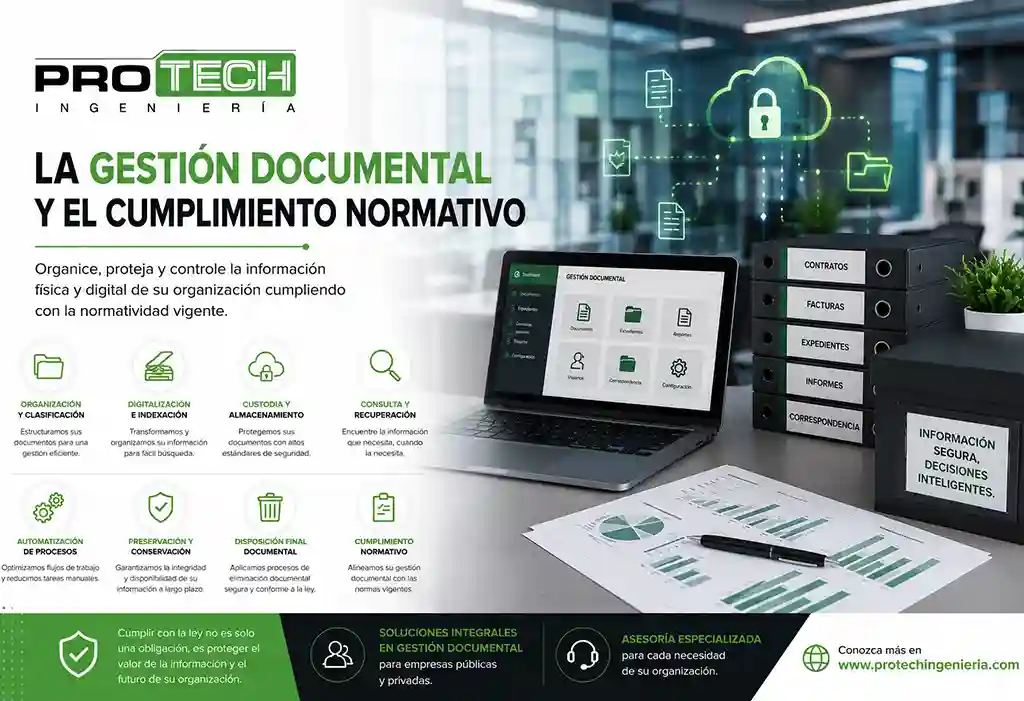
A comprehensive document management strategy must integrate different services capable of addressing the various stages of the document life cycle. Document management is not limited to storing files; it also encompasses organizational activities, control, preservation, and retrieval.
Document Organization and Classification
Classification makes it possible to group documents according to previously established criteria, facilitating their identification and retrieval. Document organization helps structure records and maintain a logical relationship between documents belonging to the same process.
This work can be complemented by the development and updating of archival instruments, document inventories, document retention schedules, and other mechanisms designed to control information.
The General Archive of the Nation provides tools related to archival instruments, TRDs, TVDs, and document management, which can serve as a reference for structuring these processes.
Document Digitization
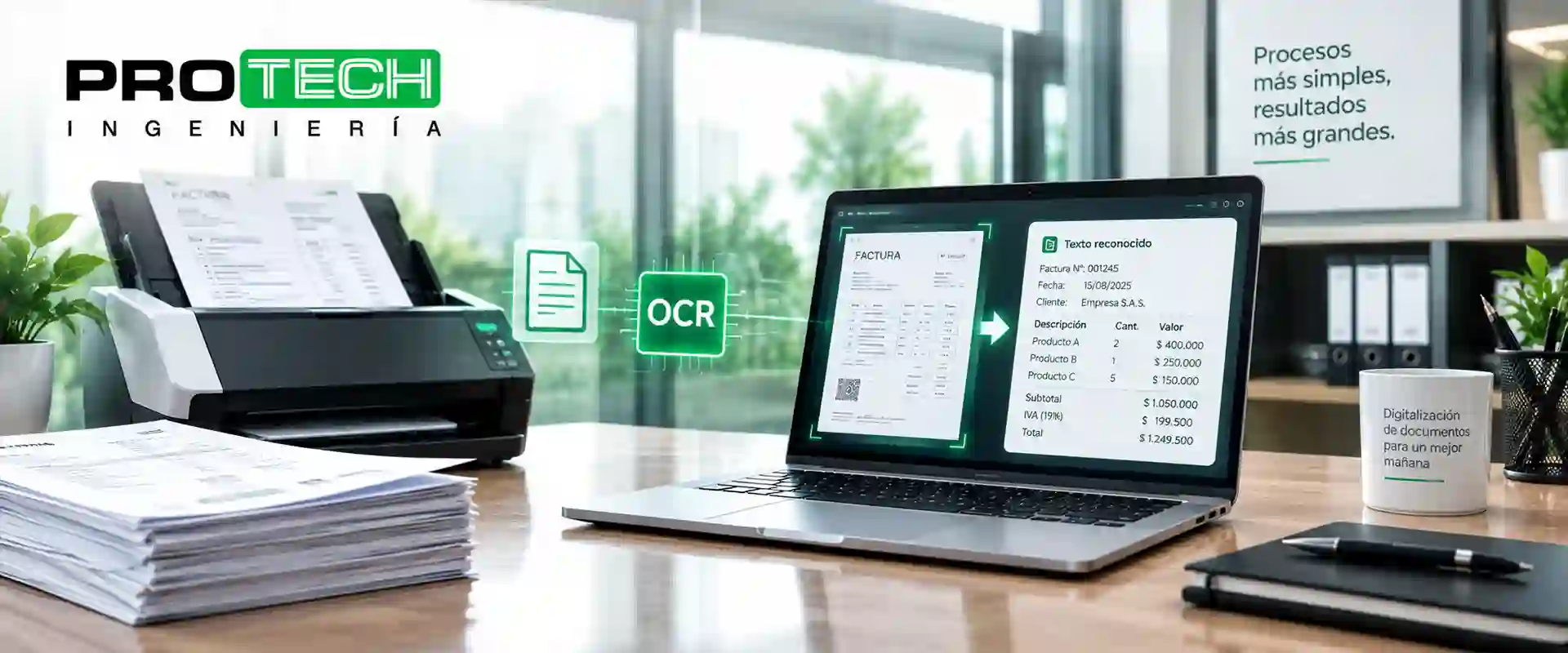
Digitization makes it possible to convert physical documents into electronic files, facilitating their retrieval and reducing dependence on physical formats. However, a digitization project must take into account criteria related to quality, identification, indexing, storage, and retrieval.
Digitizing documents without first establishing a document management structure can transfer the existing disorder of physical archives into the digital environment. Therefore, this service must be integrated with classification, indexing, and organizational processes.
Indexing and Data Extraction
Indexing makes it possible to associate relevant information with each document to facilitate subsequent searches. Depending on the project's requirements, technologies such as OCR, character recognition, and automated data extraction tools can be used.
This methodology facilitates document retrieval through different search criteria and reduces the time employees need to find specific information.
Document Custody and Storage
Document custody aims to protect physical documents through appropriate storage, organization, and security conditions. Law 594 of 2000 expressly provides for the possibility of contracting services for the custody, organization, reprography, and preservation of archival documents under the conditions established by applicable regulations.
In digital environments, storage must be complemented by backups, access controls, security mechanisms, and preservation strategies that help reduce risks associated with information loss, alteration, or unavailability.
Information Retrieval and Access
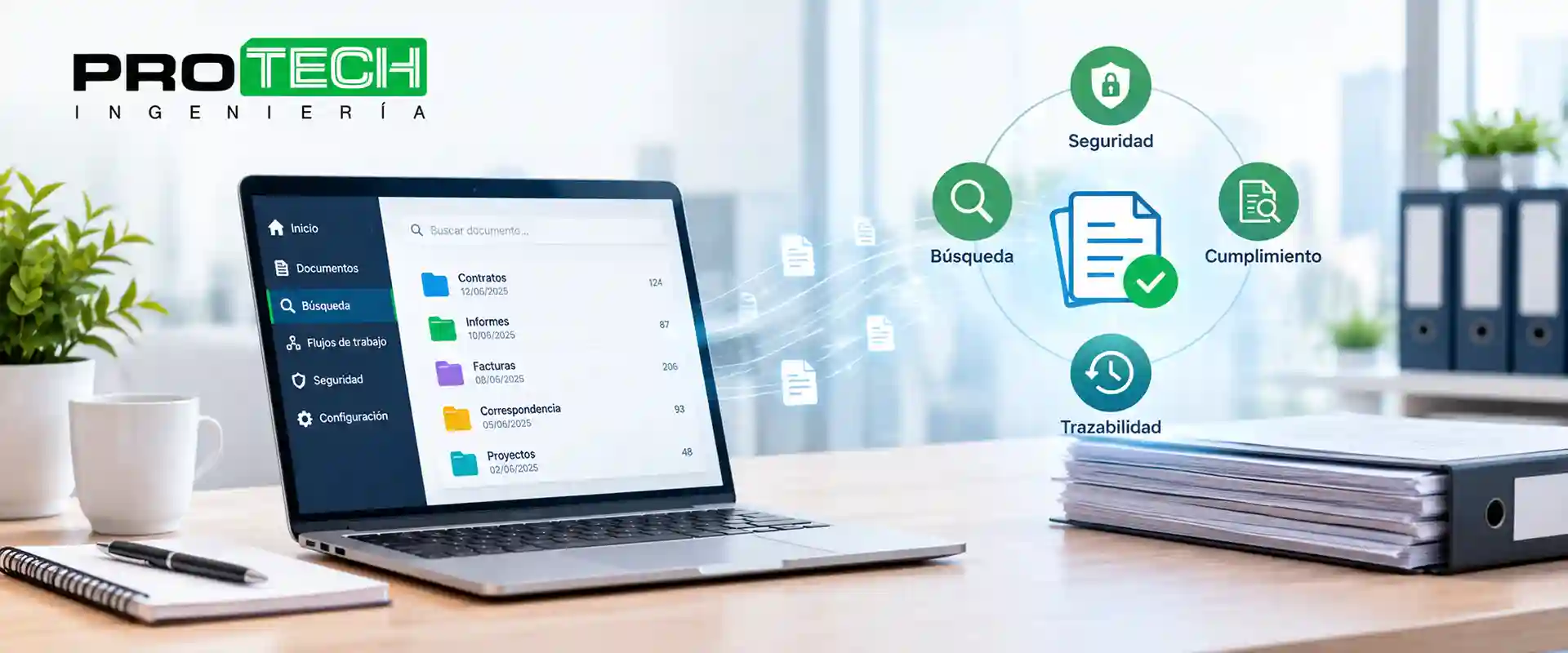
A properly organized archive must make it possible to find information whenever it is needed. Document retrieval services facilitate controlled access to records and documents, while document management platforms can incorporate search engines, filters, permissions, and traceability mechanisms.
Efficient information retrieval also contributes to regulatory compliance, as it allows organizations to respond more quickly to audits, internal requests, administrative requirements, or inquiries from authorized users.
Automation of document processes
La automatización permite establecer flujos de trabajo para reducir actividades manuales y controlar diferentes etapas de los procesos documentales. Por ejemplo, puede utilizarse para gestionar aprobaciones, asignar documentos, generar alertas, controlar tiempos y dirigir expedientes hacia diferentes responsables.
El Archivo General de la Nación ofrece recursos relacionados con la automatización y la gestión de documentos electrónicos, incluyendo contenidos sobre expedientes electrónicos y herramientas para la administración documental.
Document Preservation and Conservation
Preservation must take into account the characteristics of each format and the value of the documents. For physical archives, this involves establishing appropriate storage and handling conditions. For electronic documents, preservation requires consideration of formats, metadata, integrity, and future availability.
Article 46 of Law 594 of 2000 establishes the implementation of an integrated conservation system throughout the different stages of the documents' life cycle.
Final Disposition and Document Disposal
Not all documents need to be retained indefinitely. Final disposition determines what happens to documentation once the established retention periods have been fulfilled and the corresponding appraisals have been carried out.
Depending on the characteristics of the document and the applicable archival instruments, its permanent preservation, transfer, or disposal may be determined. Properly planned document disposal helps prevent unnecessary information accumulation and reduce the risks associated with retaining documentation that should no longer remain active.
How to Implement a Document Management Strategy Focused on Compliance?
Implementing a document management system must begin with the specific needs of each organization. Information volumes, document types, internal processes, industry sectors, and legal obligations can vary considerably.
Document Management Assessment
The first step is to understand the organization's current situation. It is necessary to identify which documents exist, where they are located, which departments produce them, which ones are accessed most frequently, and what challenges are currently being experienced.
This assessment can identify duplicate documents, incomplete records, unclassified files, information stored across different platforms, and difficulties retrieving specific documents.
Defining Procedures and Archival Instruments
After conducting the assessment, procedures must be established to regulate the creation, receipt, classification, organization, retrieval, transfer, preservation, and disposition of documents.
For entities required to comply with applicable archival regulations, these processes must be aligned with the corresponding archival instruments. The General Archive of the Nation provides resources and tools for document management that can support the structuring of these processes.
Technology Selection
Technology should be selected according to the organization's actual needs. Document management software can incorporate features for document retrieval, loans, correspondence, employment records, files, storage, and document tracking.
It is also important to evaluate its ability to integrate with other corporate systems, such as ERP, CRM, human resources platforms, financial systems, or customer service tools.
For electronic document management, the AGN and MinTIC developed a technical guide for managing electronic documents and records, which addresses aspects related to electronic archival documents, records, metadata, and their management throughout the life cycle.
Training and Change Management
Technology alone does not guarantee proper document management. Employees must understand the procedures, be aware of their responsibilities, and know how to use the available tools correctly.
Training should cover both practices related to physical documents and procedures applicable to electronic documents. This helps facilitate adaptation to new processes and promotes an organizational culture focused on the responsible management of information.
Benefits of Integrating Document Management and Regulatory Compliance
A properly structured document management strategy can generate benefits that go beyond meeting legal obligations.
Increased productivity
When documents are properly organized, classified, and indexed, employees can retrieve information more quickly. This reduces the time spent on manual searches and facilitates decision-making.
Cost Reduction
Document organization can reduce costs associated with physical storage, document duplication, reprocessing, and manual information searches. Digitization and automation also make it possible to optimize certain administrative activities.
Enhanced Information Security
Document management systems can incorporate user profiles, access permissions, controls, and tracking mechanisms. This is particularly important when records contain confidential, financial, employment-related, or personal information.
Document Traceability
Organized document management makes it possible to know what has happened to specific documents throughout their life cycle. This traceability can facilitate audit processes and help identify document movements, those responsible for handling them, and the consultations carried out on the documentation.
Therefore, document management and regulatory compliance must be approached from an integrated perspective, in which organization, digitization, indexing, data extraction, classification, custody, storage, retrieval, automation, preservation, and final disposition are all part of a coordinated strategy for properly managing information.
Strengthen Your Document Management and Turn Compliance into a Business Advantage
Don't let disorganized documents, manual processes, or difficulties locating information become obstacles to your operations and regulatory compliance. Take the next step toward more organized, secure, and efficient document management.
Start today!
Contact Protech Ingeniería for expert guidance and discover how a comprehensive document management strategy can help optimize your processes, protect your information, and strengthen your organization's regulatory compliance.