


Today, the migration of physical archives to document management systems is more than a trend—it has become an operational imperative for companies, public entities, and organizations of all sizes seeking efficiency, legal security, and process optimization. This article explores what the migration of physical archives to document management systems involves, its benefits, associated services, recommended stages, challenges, and the applicable legal framework in Colombia.
What is document management and why is it key?
Document management refers to the set of administrative and technical activities aimed at the planning, organization, processing, preservation, access, use, and final disposition of documents produced or received by an entity, regardless of their format (physical or digital). In Colombia, Law 594 of 2000 – the General Archives Law – defines document management as “the set of administrative and technical activities aimed at the planning, handling, and organization of documentation produced and received by entities, from its origin to its final destination, with the purpose of facilitating its use and preservation.”
Document management not only ensures order, traceability, regulatory compliance, and document preservation, but also serves as the foundation upon which an effective and secure migration of physical archives to digital document management systems can be built.
What does the migration of physical archives to management systems involve?
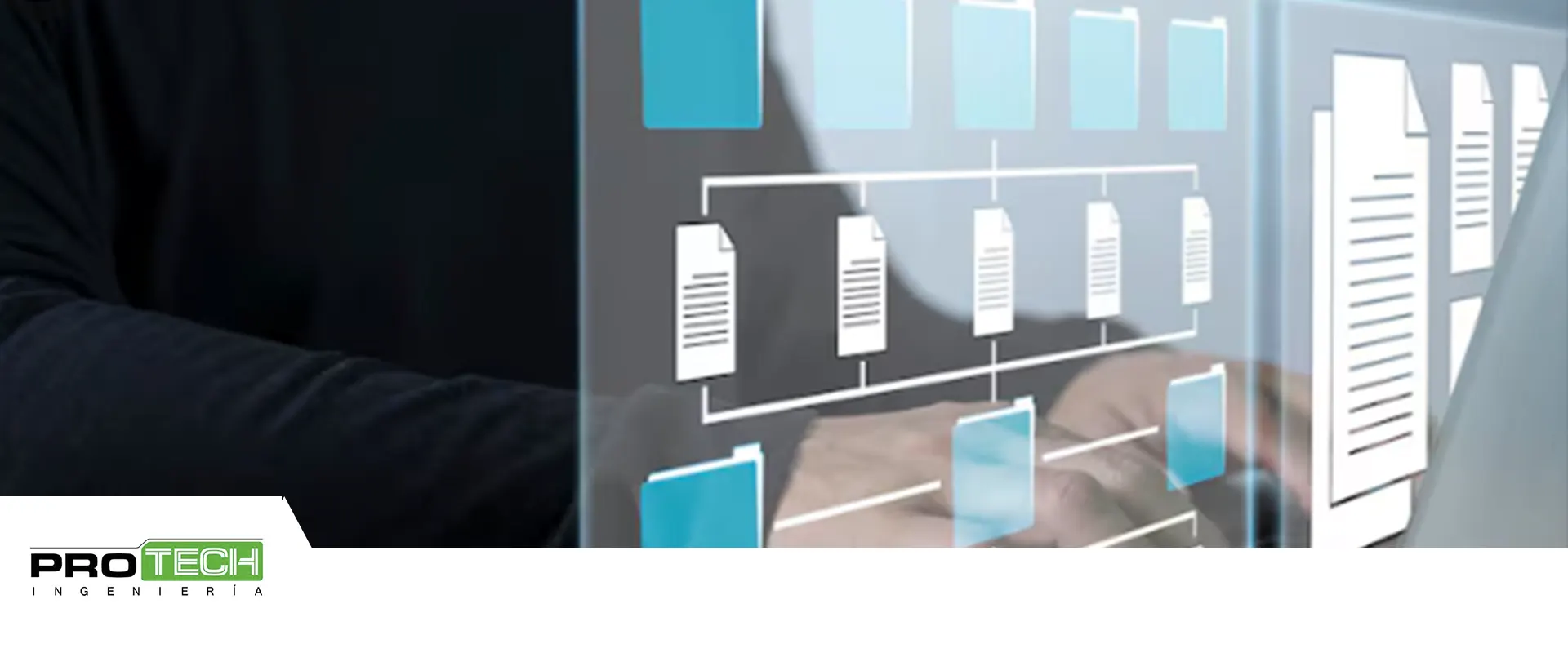
The migration of physical archives to management systems involves much more than digitizing paper documents. It is a comprehensive process that transforms the way information is handled—from the collection and selection of physical documents, through their preparation, mass document scanning, indexing, and storage, to integration with existing digital workflows, access controls, security, and document organization. It is a structural change that impacts infrastructure, organizational culture, procedures, roles, and technology.
Benefits of migrating physical archives to management systems
When addressing the migration of physical archives to digital document management systems, organizations can access multiple advantages that impact both operations and legal compliance:
1. Ease of access and faster retrieval
When documents are digitized, they can be searched using metadata, tags, OCR (Optical Character Recognition), date, type, author, or any relevant criteria. This drastically reduces the time required to locate critical documents. In addition, remote accessibility—via cloud platforms or corporate servers—allows information to be consulted from different locations or devices, facilitating remote work and distributed collaboration.
2. Security and preservation
Physical documents are exposed to risks such as physical deterioration, fires, floods, theft, or loss. The migration of physical archives to management systems makes it possible to apply mechanisms such as encryption, access control, audit logs, backups, replication, and protection against digital disasters. It also ensures document integrity and authenticity, which are essential for legal and compliance purposes.
3. Regulatory compliance and transparency
In Colombia, regulations such as Law 594 of 2000, Decree 2609 of 2012, and Law 1712 of 2014 (Transparency and Access to Information Law) govern how archives and documents must be managed, including their preservation, final disposition, access, classification, and records retention.
Implementing a well-executed migration of physical archives to management systems makes it possible to comply with these regulations, avoid penalties, and promote institutional transparency.
4. Increased operational efficiency
Less time spent searching for documents, filing, or controlling document versions; reduced use of physical space; workflow optimization; and improved coordination between departments. All of this translates into lower operating costs, higher productivity, and better service for both internal and external users.
5. Competitive advantage
Organizations that promptly adopt the migration of physical archives to digital document management systems stand out from those that continue to rely exclusively on paper-based processes. This modernization projects an image of a more agile, reliable organization that is better prepared to face future challenges.
Document management–related services that facilitate migration
To successfully carry out the migration of physical archives to management systems, it is useful to understand the associated services that can provide support throughout the process. These services include:
- Document management consulting: Assessment of the current state of physical and digital archives, design of document policies, identification of roles, processes, and applicable regulations.
- Document digitization: High-resolution scanning, OCR, document cleaning and preparation, and metadata capture.
- Indexing and cataloging: Definition of classification criteria, standard metadata, document classification schemes, and records retention schedules. This ensures that digitized documents are easily searchable and readable.
- Digital storage and repository management: Systems that allow digitized documents to be stored either in the cloud or on local servers, with redundancy, backups, encryption, and disaster recovery mechanisms.
- Document security and access control: Policies to define who can access documents, access audits and logs, protection against unauthorized access, and assurance of authenticity, integrity, and version control.
- Integration with other systems: ERP, CRM, accounting, or internal management systems, ensuring that digitized documents are not isolated but become part of business processes.
- Training and capacity building: Users, administrators, and archivists require training to properly use digital document management systems and to understand archival best practices, security, and regulatory requirements.
- System maintenance and updates: Technical support, software updates, and adaptation to new legal or technological requirements.
Common challenges in the migration of physical archives to management systems
Carrying out the migration of physical archives to digital document management systems may involve several challenges that should be anticipated:
- Volume and diversity of documents: Large quantities of materials in different formats and conditions, which complicates physical preparation, selection, and digitization processes.
- Technological compatibility: Ensuring that digital formats are compatible with the target system, that metadata is properly defined, and that technological neutrality is maintained in accordance with regulatory requirements.
- Security and long-term preservation: Maintaining the integrity, authenticity, and accessibility of digital documents in the face of technological changes, data corruption, obsolescence, and security threats.
- Initial costs: Infrastructure, software, scanners, specialized personnel, and training; although these costs are offset over time through reduced physical storage needs, improved efficiency, and less time lost.
- Resistance to change: Users accustomed to paper-based processes may show reluctance; therefore, it is essential to manage cultural change, raise awareness of the benefits, and ensure that systems are user-friendly.
- Regulatory and legal compliance: Adhering to laws, decrees, records retention schedules, document disposal regulations, and transparency requirements. Additionally, in the Colombian public-sector context, clear and well-defined institutional processes are required.
Regulations, institutions, and policies in Colombia on document management
For organizations planning the migration of physical archives to management systems, it is essential to understand the regulations and institutions that govern, define policies, and oversee document management in Colombia:
Law 594 of 2000 – General Archives Law:
Regulates document management in public entities, private entities performing public functions, and individuals or organizations holding archives of cultural interest. It establishes principles such as responsibility, institutional accountability, the importance of archives, and document integrity.
Decree 2609 of 2012:
Complements Law 594 by defining archival instruments such as records retention schedules, final disposition procedures, regulations for electronic documents, and management of the document life cycle.
Law 1712 of 2014:
Transparency and access to public information law, which has direct implications for electronic document management, document availability, and proactive disclosure of information.

Success factors in the migration of physical archives to management systems
For a migration to be truly successful, the following critical factors must be addressed:
- Senior management commitment: Without institutional support, clear budget allocation, and strong leadership, it is difficult to sustain a high-quality migration process.
- Proper analysis of the initial state: Understanding what documents exist, their condition, their value, physical formats, duplicates, and which legal or essential records must be preserved is key to planning an effective migration.
- Appropriate technology selection: Choose document management systems, digital formats, and service providers that meet requirements for security, interoperability, technological neutrality, and scalability.
- Clear policies with legal backing: Having well-defined document management policies, records retention schedules, archival manuals, and documented procedures ensures consistency and regulatory compliance throughout the process.
- Continuous training: Implementing software alone is not enough; users must be trained to search, index, classify, manage versions, apply retention rules, dispose of records properly, and use security features correctly.
- Monitoring and continuous improvement: Track metrics such as document retrieval times, error rates, user satisfaction, incidents of unauthorized access, and overall system performance to continuously refine and improve the process.
Tools and technologies that support migration
Some of the technologies and tools that enhance the migration of physical archives to digital document management systems include:
- OCR (Optical Character Recognition): converts scanned images into searchable text.
- Electronic Document Management Systems (EDMS): platforms that enable document administration, version control, metadata management, security, and remote access.
- Cloud storage: offering scalability, global accessibility, automatic redundancy, and high availability.
- Digital repositories: allow thematic organization, preservation, metadata management, and interoperability with other systems.
- Encryption and cybersecurity: protect sensitive data and ensure integrity, confidentiality, and access control.
- Process automation: approval workflows, automatic metadata generation, retention or document disposal alerts, and report generation.
- Artificial intelligence and machine learning: automatic content identification, automated document classification, detection of duplicate documents, and extraction of relevant information.
How to measure the success of migrating physical archives to management systems
The following indicators can be used to evaluate whether the migration is effective:
- Average document search time before vs. after migration
- Number of digitized documents / percentage of the total archive
- Reduction of physical storage space used
- Error rates in indexing or incorrect metadata
- Incidents related to security failures, unauthorized access, or document loss
- Internal user satisfaction with the digital system
- Compliance with legal retention periods and document disposal requirements
Do not wait for manual document management to limit your organization’s growth. Allow technology to drive productivity and improve information traceability.
Implementing this process ensures efficiency, time savings, transparency, and compliance with Colombian archival regulations, while also strengthening the security and preservation of the most valuable documents.