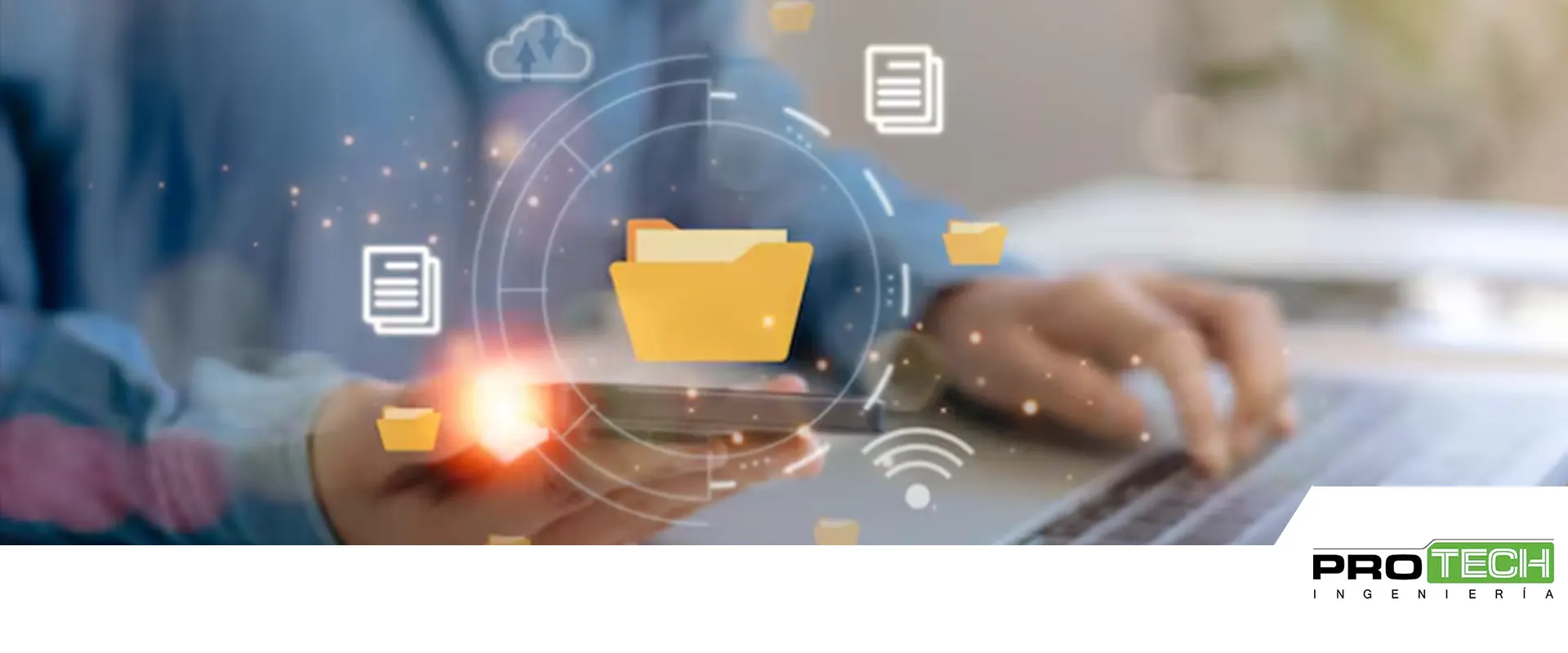


Nowadays, companies and public entities face a crucial challenge: preserving the integrity and authenticity of documents in increasingly complex digital environments. In document management, electronic files have become the central axis of corporate information, making it a legal and administrative priority to ensure their reliability and accuracy.
The Importance of Document Management in the Digital Age
Digital transformation has driven the adoption of technologies that enable digitization, document automation and inventory, optimizing file control and process traceability. In this context, document integrity and authenticity not only ensure confidence in information but also strengthen transparency, security, and decision-making within organizations.
Protech Ingeniería, a company specialized in document management technological solutions, offers tools designed to ensure that every electronic document maintains its validity, origin, and protection throughout its lifecycle.
What Is Meant by Integrity and Authenticity of Digital Documents?
The integrity and authenticity of documents refer to the ability to ensure that digital files have not been altered, come from a reliable source, and that their content is truthful and verifiable. These principles are essential in document management, where every record, file, or metadata must preserve evidence of its origin and legitimacy.
Document integrity relates to the impossibility of modifying data without leaving detectable traces. Authenticity, on the other hand, involves confirming the author or entity that issued the document, its creation date, and its legal validity.
These factors form the foundation of any secure digital filing policy within a document management system.
For further reference on regulatory principles, international organizations such as ISO and UNESCO promote standards that govern digital preservation and information authenticity.
Essential Characteristics of Authentic Digital Documents
Authentic digital documents have features that distinguish them from physical media. Some of these include:
-
Immediate accessibility and the ability to consult them from secure
platforms. -
Complete traceability through metadata that records creation, modification,
and access. -
Version control, which prevents duplication and ensures document integrity
and authenticity. -
Cryptographic protection through digital certificates or advanced electronic
signatures. -
Compatibility with open standards, ensuring interoperability and long-term
preservation.
These qualities are essential in a robust document management strategy based on policies for custody, preservation, and inventory of digital documents.
Risks of Lacking Document Authenticity and Integrity
The loss of document integrity and authenticity can have serious consequences. Files without control or traceability may contain altered, falsified, or incomplete information, affecting transparency and institutional trust.
In the business context, this situation can compromise audits, accounting records, electronic contracts, or meeting minutes. In the public sector, it can put the legal validity of official documents at risk and affect compliance with regulations such as those of the National Archive.
For this reason, organizations must adopt technologies that strengthen their document management system, implementing automatic controls for access, validation, and backup.
Key Technologies to Ensure Document Integrity and Authenticity
1. Electronic Signatures and Digital Certificates
Advanced electronic signatures are one of the main mechanisms for verifying document integrity and authenticity. Through the use of cryptography, these signatures ensure that the document has not been altered and that the signer's identity has been validated by a certifying authority.
In Colombia, the validity of electronic signatures is supported by Law 527 of 1999, which regulates electronic commerce and data messages. Their use within document management systems, ensures document security and regulatory compliance.
2. Timestamps and Digital Fingerprints (Hash)
Timestamps allow recording the exact moment a file was created or modified, providing verifiable evidence of its existence.
Digital fingerprints, or hashes, are unique codes generated by algorithms that represent the document’s content. If the file changes, the hash changes as well, alerting to any alteration.
These mechanisms are essential for maintaining document integrity and authenticity during digitization and custody processes.
3. Blockchain and Document Traceability
Blockchain technology has become a strategic ally for document management. Thanks to its decentralized structure and immutable records, it allows certifying every transaction or change made to documents.
This technology provides full transparency, as any attempt at manipulation would be recorded on the blockchain. Its application is ideal in environments where document integrity and authenticity are critical, such as in the management of legal, notarial, or financial records.
4. Electronic Document Management Systems (EDMS)
EDMS are platforms that centralize and automate document management processes within organizations.
Protech Ingeniería, for example, offers specialized modules that ensure document integrity and authenticity through features such as:
- Version control and access permissions.
- Modification auditing.
- Automated document inventory.
- Integration with digitization and custody systems.
- Metadata validation and file traceability.
These solutions enable more efficient management, reducing the risk of information loss or tampering.
5. Cryptography and Secure Cloud Storage
Cryptography protects documents through encryption algorithms that allow access only to authorized users.
Cloud storage, in turn, facilitates document availability from anywhere, provided it is implemented in environments with robust security and authentication measures.
Reliable providers implement automatic backup policies and end-to-end encryption to maintain document integrity and authenticity at all times.
Best Practices in Document Management to Ensure Authenticity
1. Control and Preservation Policies
Every organization should define clear document management policies that establish procedures for document creation, classification, digitization, and preservation. These policies should include criteria for document integrity and authenticity, specifying responsible parties, technologies used, and retention periods.
2. Use of International Standards
Applying international standards such as ISO 15489-1:2016, which focuses on records management, helps ensure traceability and preservation of information.
These standards establish principles to maintain the integrity and authenticity of documents in digital environments, ensuring their evidentiary value and long-term availability.
3. Training and Organizational Culture
The human factor also influences document integrity and authenticity. Training staff in best practices for document management, classification, use of digital signatures, and handling electronic files is essential to minimize risks and ensure the proper operation of systems.
4. Backup and Digital Preservation
Implementing regular backups and redundancy systems ensures the preservation of digital documents. These measures should be integrated into the document lifecycle and aligned with the company’s digitization and document inventory strategy.
Technological Trends in Document Authentication
Technological evolution continues to offer new tools to ensure the integrity and authenticity of documents.
Among the most notable are:
- Artificial Intelligence (AI): used to analyze large volumes of documents, detect inconsistencies, and validate metadata.
- Machine Learning: enhances verification and authentication systems through behavioral patterns.
- Biometric Recognition: combines fingerprints, facial recognition, or voice to validate the identity of signers.
- Integration with IoT: allows tracking the location and status of physical or digital documents within the document inventory.
Protech Ingeniería is advancing the implementation of these technologies within its management modules, strengthening traceability, integrity, and authenticity of documents in corporate and government environments.
Legal and Regulatory Aspects
The legal framework for document integrity and authenticity relies on laws, regulations, and international standards that support their validity.
In Colombia, entities such as MinTIC and the National Archive promote guidelines for the responsible management of digital information, while at the international level, ISO and UNESCO establish directives for the preservation of digital heritage.
Compliance with these regulations not only ensures legal security but also strengthens document management as a cornerstone of transparency and organizational efficiency.
Transform Your Organization’s Document Security with
Protech Ingeniería
At Protech Ingeniería, we offer innovative technologies that strengthen every stage of the document lifecycle. Our electronic document management modules, integrated with digital signature tools, timestamps, traceability, and version control, enable your organization to manage information with complete security, regulatory compliance, and efficiency.
Start today!
Contact Us and Discover How Our Technological Solutions Can Be Tailored to the Specific Needs of Your Organization, Ensuring the Authenticity, Integrity, and Availability of Your Documents at All Times.