


One of the most critical challenges is not only storing these documents, but organizing and managing them in a way that adds value, supports decision-making, ensures regulatory compliance, and preserves institutional memory. For this reason, it is essential to understand how to structure a central archive within the company—an organized space, whether physical or digital, that brings together semi-active documents useful for management and preserves them under clear records management control criteria.
Definition and purpose when thinking about How to structure a central archive
To determine how to structure a central archive within a company, it is first necessary to define what a central archive is within the document life cycle. According to Colombian legislation, especially Law 594 of 2000, records management includes the administrative and technical processes for the planning, creation, organization, distribution, consultation, retrieval, and final disposition of documents. Regulatory Framework The central archive is the space where documents transferred from the records management offices of the different departments of the organization are grouped—documents that are no longer used frequently but remain valid for internal, administrative, legal, or fiscal processes.
When a company understands how to structure a central archive, it can ensure that these semi-active documents remain accessible, preserved, classified, and available for legal inquiries, audits, or administrative follow-up. A well-structured central archive prevents loss, duplication, and unauthorized access, and improves operational efficiency.
Essential components when describing how to structure a central archive
To fully understand how to structure a central archive within a company, it is necessary to consider several components that are part of records management:
1. Document life cycle
Understanding the stages a document goes through from its creation to its final disposition: production or receipt, active use, transfer to the central archive, preservation, and final disposition (whether elimination, destruction, or permanent preservation). Law 594 establishes these processes as mandatory for public entities; and although private companies are not always legally required to comply with all of them, adopting these principles adds rigor and supports compliance._
2. Archival instruments
They are key tools for document management. To know how to structure a central archive within a company, it is essential that the following exist and are used:
- Document Retention Schedules (TRD): define how long a document must remain in active management, in the central archive, or in another stage of the document life cycle, and when it may be eliminated.
- Document Appraisal Tables (TVD): help determine the administrative, legal, historical, or cultural value of documents and their final disposition.
- Document classification schemes: systems for organizing documents by series, subseries, types, functions, or subjects.
- Document inventories: up-to-date lists of existing documents, their location, format, and condition.
3. Policies, regulations, and documentary quality standards
Knowing how to structure a central archive within a company involves establishing clear rules regarding documentary responsibility, confidentiality, integrity, authenticity, traceability, and accessibility. In Colombia, Law 594 of 2000 mandates that entities implement document management programs, observing archival principles and standards related to facilities, custody, ownership, and the handling of documents.
4. Documentary roles and responsibilities
To maintain effective document management and understand how to structure a central archive within a company, each department must have designated personnel responsible for the records office, transfer to the central archive, monitoring standards, digitization where applicable, lending, and security. These responsible parties ensure that processes are consistent and that retention periods, access rules, and the final disposition of documents are properly followed.
5. Digitization and technology
Digital transformation turns many physical processes into digital ones. When designing how to structure a central archive within a company, it is necessary to consider the use of document management systems (DMS), digital backups, secure copies, the integrity of digital documents, metadata, search indexes, and controlled access. This facilitates retrieval, reduces the need for physical space, improves traceability, and enhances regulatory compliance more efficiently.
6. Security, preservation, and conservation
Part of document management involves ensuring environmental conditions, physical security (safe physical space, protection against fire, humidity, pests), as well as digital security (backup copies, protection against attacks, encryption when necessary). When designing how to structure a central archive within a company, these factors must be considered to preserve both physical and digital documents for the periods specified by the TRD/TVD.
Steps to implement how to structure a central archive within a company
Now, once the theory is understood, the practical part: how to structure a central archive in the company, step by step?
1. Initial documentary assessment
First, a inventory of existing materials should be conducted: active, semi-active, and historical documents; formats (paper, electronic, audiovisual, etc.), volume, and location. Assess which documents are useful and which have legal, administrative, or historical value. This helps determine the size of the central archive, the resources required, and the necessary software or physical infrastructure.
2. Design of the central archive model
Using the information from the assessment, design the structure of the central archive: its physical or digital organization, document series and subseries, classification criteria, rules for transfers from the records office, retention decisions, access, lending, and final disposition. Establish a responsibility chart. Determine whether to use digital storage or a mixed format if appropriate.
3. Development of internal policies, procedures, and regulations
Create internal policies that define and regulate: who decides on the transfer of documents to the central archive; how digitization is carried out; how document quality is controlled; which metadata are used; how access permissions are managed; how confidentiality is protected; how document disposal is performed according to the TRD/TVD; how backups are made; and how lending records are maintained. All of this within the framework of document management.
4. Implementation of archival instruments
Put into operation the Document Retention Schedules, Appraisal Tables, document classification schemes, inventories, and preservation policies. Establish internal archive committees if applicable and assign responsibilities. Begin organizing existing documents according to the defined criteria—transfer semi-active documents from the producing offices to the central archive, respecting the retention periods specified in the TRD.
5. Physical or digital infrastructure
If the central archive is physical, it must have adequate space, shelving, furniture, environmental conditions, access control, and security. If it is digital, a robust technological platform is required, including document management systems, backup, IT security, advanced search capabilities, properly applied metadata, possible format conversions, and digital integrity.
6. Document transfer process
Define the procedures for moving documents from the records office to the central archive. Establish transfer times and criteria based on usage, validity, and legal value. Ensure that transferred documents are complete, that their physical or digital condition is adequate, that the transfer is properly recorded, and that users know where to locate these documents.
7. Training and documentary culture
For everything to function properly, employees must know how to structure a central archive within the company. This involves continuous training in document management: applicable laws and regulations (e.g., Law 594 in Colombia), internal procedures, use of the archive system, digitization, preservation, and document security. Promote a culture of documentary responsibility.
8. Control, monitoring, and continuous improvement
Once the central archive is structured, its operation must be monitored: conduct internal audits, access controls, verify compliance with retention periods, track lending records, use of the digital system, and physical and digital integrity. Adjust procedures as laws, technology, and company needs evolve.
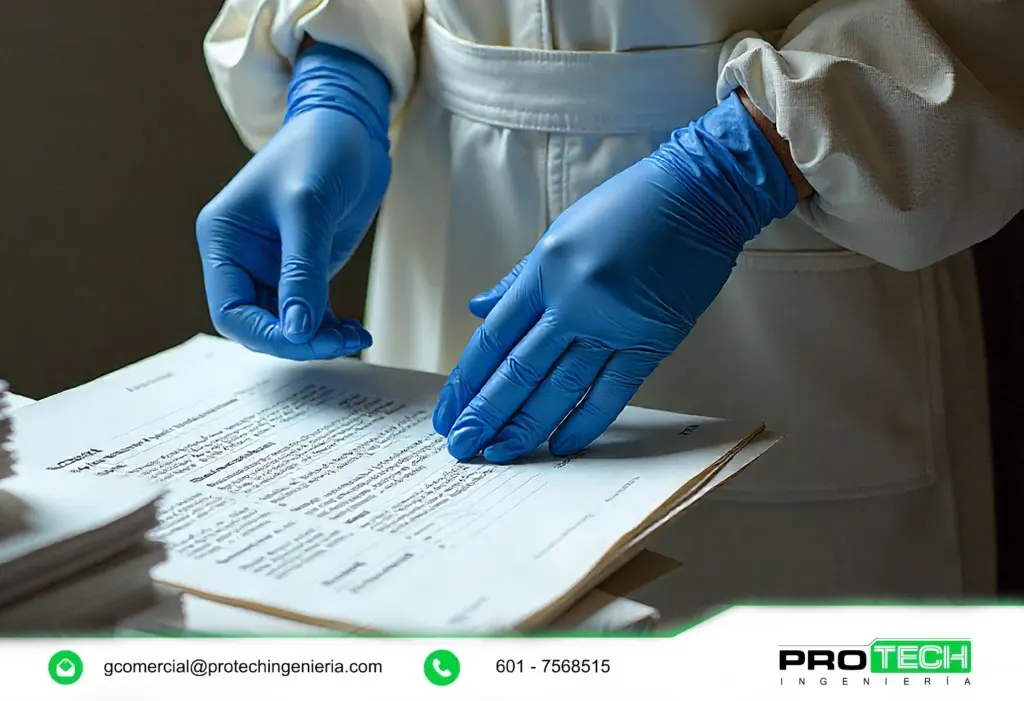
Practical examples of how to structure a central archive within a company
To better illustrate how to structure a central archive in a company, here are examples adapted to different types of organizations:
Small professional services company
Has few employees and handles client documents, contracts, invoices, correspondence, and reports. Here, the central archive can be mixed: retain relevant physical documents and maintain a digital backup. Classification can be done by client (alphabetically), by type (contracts, invoices, projects), and by date. Create an appropriate internal TRD, assign a single documentary responsible person, provide modest but secure physical space, and perform selective digitization.
Medium-sized manufacturing company
Handles many technical documents, purchase orders, quality control records, logistics, and environmental regulations. Structuring a central archive in this type of company requires a more robust setup: broad thematic series (production, logistics, quality, environment); well-defined TRD; intensive digitization; use of a DMS (document management system); off-site backups; policies to define the lifespan of technical versus administrative documents; and a document management committee.
Large corporation or public entity
Handles high volumes of documents, faces legal requirements, frequent audits, and the obligation to preserve historical records. Structuring a central archive in such an organization involves a well-sized physical central archive, possibly multiple digital repositories, advanced ICT infrastructure, strict compliance with national archival standards, legal support, specific policies for security, access, and long-term digital preservation, cataloging with metadata, and even disaster contingency plans.
National regulatory framework
When designing how to structure a central archive within a company, in Colombia there are key regulations that cannot be ignored:
-
Law 594 of 2000: General Archives Law. Defines document management, the document life cycle, and the obligations of public entities in the handling and preservation of their archives.
-
Complementary regulations such as Decree 1080 of 2015 (Single Regulatory Decree of the Culture Sector), which governs various aspects of document and archive management.
-
Agreements from the National Archives that establish the Unified Archive Function Agreement, the Unique Registry of Document Series, TRD certifications, and more. These regulations set standards for validity, authenticity, integrity, and preservation.
Common challenges when structuring a central archive
When a company decides to implement a central archive, it faces several obstacles:
- Resistance to change: employees accustomed to disorganized documents, keeping multiple versions, and not following procedures.
- Limited resources: physical space, budget for digitization, technology, and trained personnel.
- Digital document management: ensuring authenticity, integrity, metadata, stable storage, and mitigating the risk of technological obsolescence.
- Regulatory compliance: understanding and applying national laws, international standards if applicable, data protection regulations, and legal retention rules.
- Information security: both physical and digital, including access control, backups, and disaster recovery.
Visible impacts
When the central archive is properly structured in a company, effects can be seen both operationally and strategically:
- Improved productivity: less time spent searching for documents, fewer errors from using outdated versions, and smoother administrative processes.
- Legal compliance ensured: the company can demonstrate that it retains documents according to the TRD, respond to audits, and maintain document integrity.
- Institutional transparency: documented access, traceability of decisions, and a clear history of contracts and communications.
- Protection of documentary heritage: historical or culturally significant documents are well preserved, not destroyed due to ignorance or negligence.
- Enhanced decision-making: having reliable, organized, and accessible documents allows for analyzing background information, assessing risks, and planning strategies based on data.
Recommended resources and tools
To effectively know how to structure a central archive within a company, it is useful to use the following tools and resources:
- Document management software (DMS / Document Management System): platforms that allow storage, indexing, searching, version control, permission management, and workflow approval management.
- Digitization systems with standards: quality scanners, OCR, formats that ensure digital preservation, and well-structured metadata.
- Secure physical infrastructure: filing cabinets, mobile shelving, fire protection systems, humidity and light control, and restricted access.
- Document management training: courses, workshops, and continuous training for archive personnel, document-producing areas, management, and auditors.
- Internal archive committees / document managers: groups responsible for supervising compliance, updating TRD/TVD, and monitoring processes.
- Audits and periodic evaluation: internal reviews, document quality controls, and indicators such as search times, version standardization, loan tracking, and usage records.
Does your company already have a well-structured central archive?
Don’t wait for disorganization, document loss, or regulatory non-compliance to affect your productivity. Implementing clear strategies on how to structure a central archive within your company not only optimizes internal processes but also strengthens security, traceability, and legal compliance.
Start today!
At Protech Ingeniería, we help you design and implement comprehensive document management solutions aimed at creating an efficient, compliant central archive fully tailored to your company’s needs.