



RFID technology, which allows remote reading and writing of a large amount of information stored in the so-called RFID tags, has become a solution with increasingly broad and versatile applications in different sectors. Although it is a technology that has been in development for many years, in the last decade it has experienced exponential growth in terms of functionalities, accuracy, and cost reduction. This constant progress has made it possible for RFID to find a prominent place in document management, opening new opportunities to integrate physical documents into secure and efficient digital environments. In this context, the applications of RFID in physical documents stand out, allowing traceability, control, and security for files, archives, and paper records.
In its early stages, RFID was conceived as a more advanced substitute for the traditional barcode, as it offered significant benefits in reading speed, data storage capacity, and reduction of human errors. However, over time, it has been applied in much more diverse fields, even unimaginable in its initial stages: from security and personnel management to logistics, traceability, document custody, and, currently, document management.
Applying RFID in document management makes it possible to integrate paper documents and other physical media into digital information control systems in a more controlled and agile way. In a context of transition toward electronic administration, this integration serves as a fundamental link, as it facilitates the connection between the physical documentation that continues to be generated and the increasingly predominant digital environments, offering an orderly and secure process of evolution.
What are RFID tags?
RFID (Radio Frequency Identification) tags are small devices designed to identify a product, asset, or document wirelessly, ensuring traceability and enabling much more efficient information control. These tags function as smart devices capable of storing relevant data and transmitting it via radio waves, which are instantly captured by specialized receivers. In this sense, the applications of RFID in physical documents are especially valuable, as they make it possible to identify, locate, and manage paper-based files and records quickly and accurately.
Despite their small size, they have a large storage capacity, which makes it possible to track a product or document throughout the entire supply chain. From raw material to final delivery, traceability is recorded, ensuring continuous control. Thanks to this system, company employees can access in real time the data stored in RFID tags, which helps optimize inventory management, replenishment, classification, and the overall organization of resources.
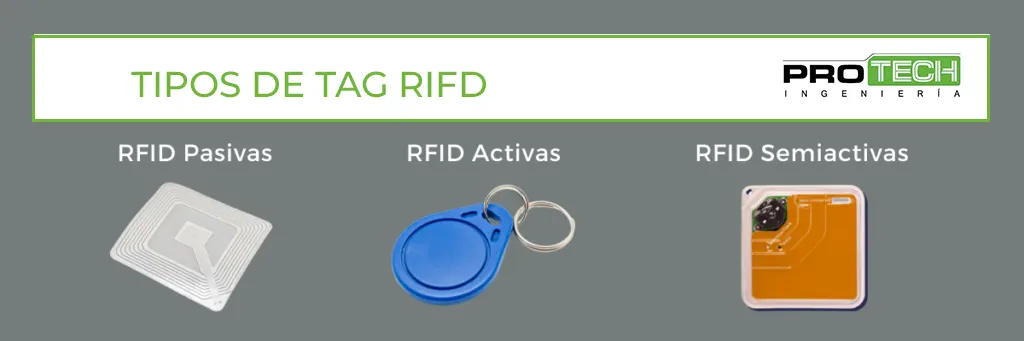
The structure of an RFID tag combines an electronic chip with an antenna, elements that together form what is known as an RFID inlay. There are three main types of RFID tags, which differ based on their power source:
-
Passive tags:
They lack their own battery, so they depend on the signal emitted by the RFID reader to activate. Their reading range varies between 0 and 15 meters, making them ideal for short-range applications. They are the most common due to their small size and low cost.
-
Active tags:
They incorporate an internal power source that allows them to constantly transmit signals. They have a much greater reading range, up to 100 meters, making them a powerful option, although more expensive due to the integrated battery.
-
Semi-active tags:
They function as an intermediate option between passive and active tags. They are activated by the reader’s signal but also contain a battery to power the chip, which allows them to respond more quickly and securely. Their range is greater than that of passive tags, although their cost and lifespan are affected by the battery.
Main functions of RFID in document management
1. Traceability and location
RFID makes it possible to know the exact location of a document in real time, allowing constant monitoring and significantly reducing search times that usually occur in traditional archiving processes. This helps minimize losses and misplacements, while optimizing efficiency in locating critical information. Within this context, the applications of RFID in physical documents provide a differential value, as they facilitate the quick identification of paper-based files and records without the need for direct handling.
2. Security
The wireless identification of documents makes it possible to implement additional security measures. For example, access controls can be established for sensitive information, or the removal of specific documents from designated areas within an organization can be restricted.
3. Authentication and validation
The use of read-and-write tags makes it possible to introduce digital signatures into documents, ensuring the authenticity of their content and providing a higher level of control in document management processes.

Applications of RFID tags
RFID tags have become a versatile tool with an ever-growing range of applications, as they add value in any sector where identification, traceability, security, and process automation are essential. Unlike traditional methods such as barcodes or manual recording, RFID offers the ability to read multiple objects at the same time, without the need for physical contact or direct line of sight, which speeds up processes and ensures greater accuracy. Within this framework, the applications of RFID in physical documents stand out, enabling the agile and secure integration of paper-based files, records, and archives into digital management systems.
Among the most notable applications are:
Supply chain management
RFID makes it possible to monitor the flow of goods in real time from manufacturing to the point of sale. Thanks to this technology, batches can be identified, inventory movements recorded, order errors detected, and losses during transport prevented. This translates into greater transparency and trust among suppliers, distributors, and customers.
Industrial sector
Factories use RFID tags to identify raw materials, parts, and finished products within production lines. This not only reduces manufacturing times but also enables more thorough quality control, the detection of anomalies in automated processes, and ensures compliance with international standards.
Automotive and aerospace
In these sectors, where the traceability of each component is crucial, RFID tags make it possible to record when and on which machine a specific part was assembled, facilitating the detection of faults and ensuring the safety of the final product.
Logistics and transportation
In distribution centers and warehouses, RFID speeds up the reception and dispatch of goods, prevents bottlenecks in package sorting, and significantly reduces human errors. In addition, it integrates easily with ERP systems and logistics management platforms, ensuring a continuous flow of information.
Retail and fashion
RFID is revolutionizing retail by enabling near real-time inventory control. Retailers can know exactly which items are in stock, detect misplaced products, optimize shelf replenishment, and offer innovative customer experiences such as smart fitting rooms or automatic checkout systems without the need for individual scanning.
Healthcare and pharmaceutical sector
The use of RFID tags in hospitals makes it possible to identify patients, locate critical medical equipment, and control the dispensing of medications. In pharmacies and laboratories, this technology ensures the traceability of supplies and compliance with health safety regulations.
Food industry
RFID ensures the traceability of food from farm to table, verifying cold chain temperatures, expiration dates, and the origin of each product. This provides added value in terms of food safety and consumer trust.
Libraries, archives, and document management
In this field, RFID tags are applied to quickly identify and locate books, journals, or files within large repositories. They also facilitate automated lending and return processes, reduce search times, and improve security by preventing the unauthorized removal of materials. These functions clearly reflect the applications of RFID in physical documents, where the integration of technology and paper-based records becomes a key resource for the modernization of document management.
Enterprise asset management
Organizations use RFID to control the location and condition of their assets, such as computers, machinery, vehicles, furniture, and telecommunications equipment. This prevents losses, facilitates audits, and reduces costs associated with unnecessary replacements.
Access control and security
Both in private companies and government entities, RFID tags are used to restrict entry to sensitive areas, monitor the entry and exit of employees and visitors, and ensure greater control over people and vehicles in strategic facilities.
Principles of RFID technology
RFID technology is based on the use of electromagnetic fields to automatically identify and track tags placed on different objects. These tags contain electronic data that can be captured at a distance, without the need for direct line of sight. An RFID system is made up of three essential elements: the RFID tag, the RFID reader, and a database. The RFID tag, which is attached to documents, incorporates a microchip along with an antenna. The reader emits radio signals that energize the tag and allow the reading of its information, which is then transferred to the database for management and analysis. Within this framework, the applications of RFID in physical documents become a strategic tool to ensure traceability, control, and security in paper-based files and records.
1. Structure of RFID tags:
RFID tags are made up of three fundamental elements, whose quality must be high to ensure the proper performance of the device. This basic structure is key to guaranteeing the reliability of the technology in multiple fields, including the applications of RFID in physical documents, where precise identification and the durability of the tags are essential for the management of paper-based files and records.
2. Substrate or base material:
This is the part responsible for holding together the other components of the tag. It is generally made from a thin, flexible polymer or some type of plastic material. Its function is to withstand the environmental conditions the tag may face throughout its entire lifespan, which is why it can be manufactured in various materials such as cardboard, metal, or plastic. Depending on the usage environment, performance requirements vary; they are not the same for a tag intended for logistics processes as for one designed to operate in freezing chambers. A protective layer of PVC, epoxy resin, or adhesive paper is often added, allowing the tag to be attached to the desired object.
3. Antenna:
It is the largest component and is directly connected to the chip. The geometry of the antenna determines the frequency at which the tag will operate. It is usually made of a conductive material, such as copper or aluminum, whose task is to capture the signals sent by RFID readers. Depending on the type of tag, the signal can either be retransmitted (in active tags) or reflected (in passive tags). To select the most suitable antenna, it is necessary to consider the reading processes to which the product will be exposed throughout the supply chain.
4. RFID Chip:
It is an integrated circuit that includes memory and a microprocessor capable of performing basic operations. To function, it requires a power source. In the case of passive tags, the chip draws energy from the radio waves captured by the RFID system’s antenna. In contrast, in active tags, this energy comes from a built-in battery. There are different memory configurations and security levels; however, in most applications, limited capacities are sufficient, starting from 128 bits.
Types of RFID Tags
The correct choice of an RFID tag depends both on the product to be identified and on the environment in which it will be used. For this reason, there are different types of tags designed for specific applications. They are developed under the required standards to ensure that every need is met, offering a wide variety of materials—such as standard paper, polyethylene, polyamide, cardboard, among others—and different delivery formats, whether in rolls, zig-zag, or individually. Within these options, Applications of RFID in physical documents also stand out, a growing field where this technology enhances the traceability and security of paper records.
The main types of RFID tags available are:
Standard RFID Tags
Thanks to their versatility in materials, sizes, integrated circuits, and memory capacities, they can be adapted to multiple applications. They are certified under international standards and can be printed on any conventional RFID printer. Standard tags are manufactured in various formats and with multiple internal circuit and memory configurations, making them useful in logistics, industrial processes, plastic containers, and many other areas. These same features also help strengthen the Applications of RFID in physical documents, enabling fast and accurate identification of records.
Durable RFID Tags
Designed to withstand extreme conditions, these tags are ideal for long-term applications. They are used on pallets, boxes, or automotive parts that require resistance to chemicals, water, or high temperatures. They can also be adapted to archival environments where physical documents need to be kept secure under challenging environmental conditions, thus contributing to enhanced Applications of RFID in physical documents.
RFID Timing Tags
Designed to withstand extreme conditions, these tags are ideal for long-term applications. They are used on pallets, boxes, or automotive parts that require resistance to chemicals, water, or high temperatures. They can also be adapted to archival environments where physical documents need to be kept secure under complex environmental conditions, thereby improving the Applications of RFID in physical documents.
RFID Tags for Metal Surfaces
They are specially designed to prevent the interference that metals cause in radiofrequency transmission, thus enabling accurate detection. They are widely used in industries such as metallurgy, automotive, and aviation. Although their main use is not in document management, the principles they apply reinforce the effectiveness of Applications of RFID in physical documents, by ensuring reliable readings even in complex environments.
RFID Tags for Retail
These include options such as heat-sealed, textile, or hang tags, designed for manufacturers of clothing, footwear, and accessories. They are among the most widely used in the sector due to the benefits they provide in identification, control, and customization. They also offer printing and encoding services, allowing the brand’s identity to be reflected and product data to be collected. Likewise, the advances achieved in this sector have contributed to optimizing the Applications of RFID in physical documents, where label customization is key.
RFID Tags for Vehicles
They are used in access control systems, logistical identification, and vehicle detection and verification. These tags ensure reliable traceability and must be designed for all types of vehicles: cars, trucks, or buses. Their materials should not leave residues and must be able to withstand external environmental conditions.
At Protech Ingeniería, we drive the modernization of physical archiving processes through the implementation of RFID solutions tailored to each organization.
Start today!
Contact us today and discover how the applications of RFID in physical documents can transform the way you manage your files.