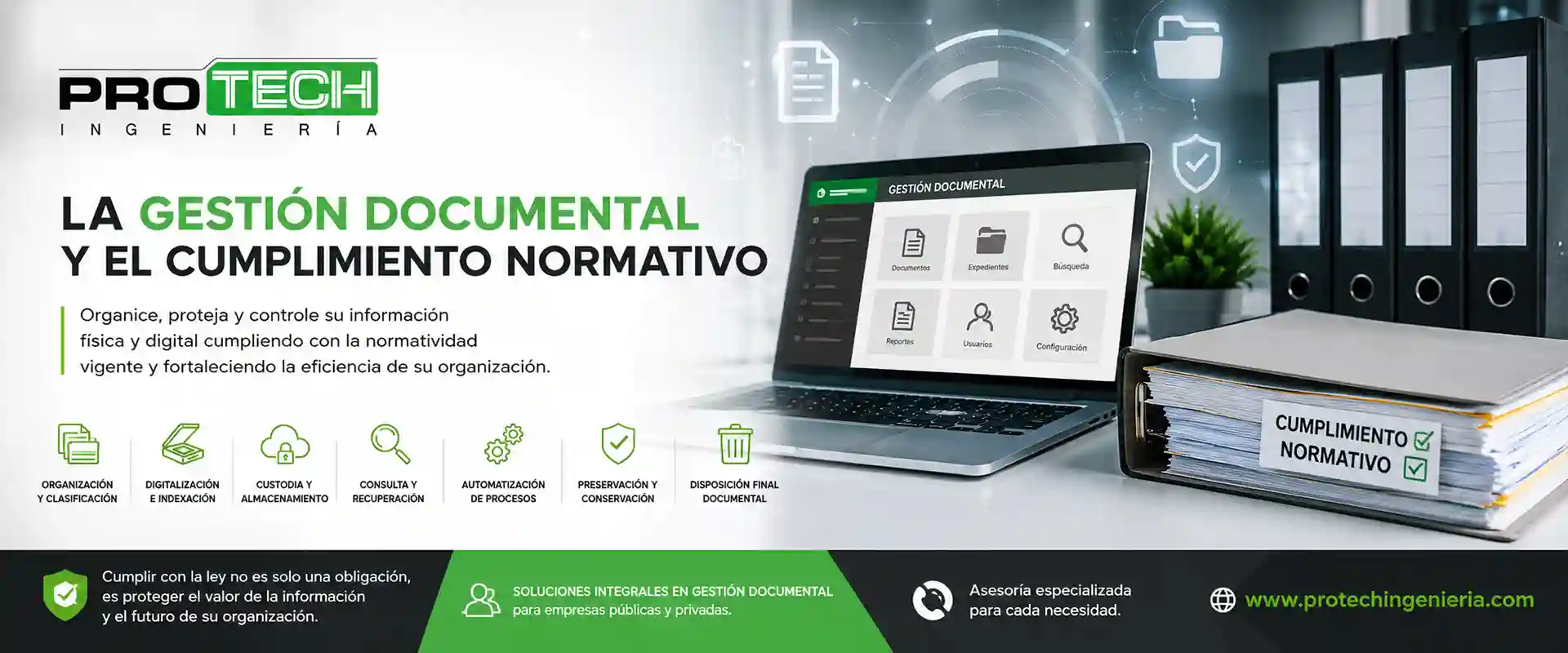



Digitalization and document management have established themselves as strategic pillars for both private companies and public entities. In a scenario where information is growing exponentially, organizations that do not modernize their processes risk falling behind more agile, efficient, and digitally prepared competitors.
Digital transformation is no longer an option; it has become an urgent necessity. Integrating technologies such as automation, artificial intelligence, or blockchain is no longer a privilege reserved for large corporations—it is the only way to ensure faster, safer, and more sustainable processes. Those who remain tied to paper will face productivity barriers, higher costs, and a clear loss of competitiveness.
The year 2026 will mark a turning point. Mature technologies such as artificial intelligence, blockchain, predictive analytics, and cloud computing will align with critical needs for security, sustainability, and operational efficiency. In this context, **document digitalization in 2026** will establish itself not only as a trend but as an essential requirement to ensure continuity, growth, and leadership in an increasingly digitalized market.
Digitalization: An Indispensable Resource in the Information Age
Information is the most valuable resource in today’s economy. Every day, companies generate thousands of data points in contracts, invoices, reports, medical records, communications, and files. Keeping this information in physical form is no longer viable: it entails high storage costs, risks of loss, and excessive retrieval times.
Document digitalization in 2026 will not be limited to converting paper into digital files. It will involve building an integrated document management ecosystem where the capture, organization, classification, storage, and access to information are carried out intelligently, securely, and strategically.
In this regard, digitalization will no longer be seen as a mere technical process but will establish itself as the foundation of productivity, innovation, and competitiveness in a globalized market.
Why will document digitalization be key in 2026?
The year 2026 will mark a turning point in how organizations manage their information. Several factors converge to make **document digitalization in 2026** no longer optional, but an essential requirement to ensure continuity, security, and competitiveness:
-
Stricter regulations:
Governments and regulatory bodies will require complete traceability, enhanced data protection, and transparency in document management.
-
Exponential growth of information:
The volume of business data will grow relentlessly, making management in physical form unfeasible.
-
Global competitiveness:
Organizations that do not adopt modern document management systems will be at a disadvantage compared to more agile and digitalized competitors.
This outlook aligns with the insights shared at the Diálogos EFE Empresas: The Impact of Technology and Digitalization on Work, Global Trends 2025-2026 event, where experts highlighted that digitalization, automation, and artificial intelligence will shape organizational competitiveness worldwide.
Document digitalization in 2026 will not only reduce costs but also enhance efficiency, information security, and innovation capacity—key factors for success in an increasingly dynamic and technology-driven market.
The 8 main trends for document digitalization in 2026
1. Intelligent automation of document processes
Automation will be the undisputed protagonist of document digitalization in 2026. It’s not just about replacing manual tasks with digital systems, but about implementing processes that can learn, adapt, and optimize themselves.
Main characteristics of this trend:
- Automatic data capture with accuracy exceeding 99%.
- Document classification based on content, context, and semantics.
- Workflows That Adjust and Correct Themselves Autonomously
- Reduction of up to 80% in repetitive manual tasks.
A practical example: a financial institution can process thousands of loan applications in minutes thanks to automation, avoiding human errors and speeding up approvals.
2. Hybrid Cloud Document Management
By 2026, the cloud will no longer be just a storage space; it will become the cornerstone of collaboration and business continuity. The hybrid model (a combination of public and private cloud) will be the most adopted by organizations.
Key benefits of this trend:
- Remote and secure access to documents from any location and device, 24/7.
- Automatic scalability according to each organization’s demand.
- Cost reduction through pay-as-you-go models.
- Immediate information recovery in disaster scenarios.
- Real-time simultaneous collaboration among distributed teams.
For an SME, this means having access to the same technology as a multinational company without needing to invest millions in its own infrastructure.
3. Artificial Intelligence and Machine Learning
Artificial intelligence (AI) will be the ultimate tool to transform archives into intelligent assistants that anticipate user needs.
Revolutionary applications:
- Semantic search: locate documents by meaning, not just by keywords.
- Predictive analysis: anticipate which documents each department of the organization will need.
- Intelligent extraction: automatically identify and classify critical data in invoices, contracts, or reports.
- Anomaly detection: detect duplicates, outdated documents, or potential fraud attempts.
Imagine a hospital where AI automatically prioritizes medical records based on case urgency.
4. Blockchain for Document Authentication and Traceability
Digital trust will become an essential requirement, and blockchain will establish itself as the gold standard for ensuring the authenticity and integrity of document digitization by 2026.
Transformative advantages:
- Immutability: documents cannot be altered without leaving a verifiable trail.
- Complete traceability: every modification and access is recorded in an auditable history.
- Instant authentication: verify the validity of a document in seconds.
- Smart contracts: automation of legal and administrative processes without intermediaries.
Sectors such as healthcare, government, and finance will be the first to adopt this technology, ensuring compliance with international regulations and reducing verification costs.
5. Digital Sustainability and the Circular Economy
Sustainability will be one of the main drivers of document digitization in 2026. Paper reduction and efficient energy use will be integrated into companies’ social and environmental responsibility policies.
Positive environmental impact:
- 95% reduction in paper usage.
- 60% reduction in physical storage costs.
- Energy optimization through intelligent systems.
- Acquisition of green certifications as a differentiating value.
- Automated reporting of the document carbon footprint.
A bank that digitizes its operations not only saves costs but also projects a corporate image aligned with sustainability—a factor increasingly valued by clients and investors.
6. Augmented Reality and Interactive Documents
Augmented reality (AR) will open new possibilities for interacting with documentary information.
Expected innovations:
- 3D documents that allow detailed exploration of technical manuals.
- Dynamic QR codes providing instant contextual information.
- Overlaying information on physical documents to guide processes.
- Immersive training with step-by-step real-time guides.
- Technical documentation that activates based on the usage context.
An example: an engineer can receive visual instructions on AR glasses while repairing a machine, accessing digital manuals in real time.
7. Process Automation with RPA
Robotic Process Automation (RPA) will be one of the most influential technologies in the future of document management. Thanks to intelligent bots, organizations will be able to accelerate repetitive tasks and ensure greater accuracy in information processing.
Key features:
- Automatic data entry across multiple systems without human intervention.
- Mass migration of information from legacy platforms to modern environments.
- Immediate handling of simple customer and user requests.
In this way, document digitization in 2026 will not be limited to digital storage but will be directly integrated into intelligent workflows, optimizing processes and reducing response times.
8. Predictive Analytics and Document Big Data
Document management will move beyond an administrative task to become a source of strategic intelligence.
Analytical capabilities:
- Identification of the most and least used documents.
- Anticipation of informational needs by department or project.
- Detection of bottlenecks in document workflows.
- Sentiment analysis in corporate communications.
- Predictions on future documentation volumes.
For example, a university could accurately anticipate how many student records will need digitization each semester and prepare its resources in advance.

Benefits for Companies Adopting Digitization in 2026
Adopting document digitization in 2026 will bring multiple benefits for companies:
- Time and Cost Savings: fewer manual processes and greater efficiency.
- Better Decision-Making: immediate access to reliable information.
- Business Continuity: secure documents in the cloud, with no risk of physical loss.
- Improved Customer Service: faster response times and personalized attention.
- Legal Compliance: alignment with archival, custody, and data protection regulations.
These benefits make digitization a strategic asset, not just a technological tool.
Use Cases Where Document Digitization in 2026 Will Be Critical
- Healthcare: digital medical records, securely accessible with full traceability.
- Legal: judicial files managed in real time.
- Banking and Finance: contracts, policies, and digital receipts backed by blockchain.
- Education: digitized academic records and electronic certificates.
- Government: historical archives digitally preserved with transparent citizen access.
In all these sectors, digitization will be synonymous with efficiency, transparency, and trust.
Keys to Implementing Document Digitization in 2026
For companies to fully benefit from digitization, it will be essential to follow several recommendations:
- Conduct an initial assessment of existing archives.
- Define a document management policy aligned with regulations.
- Select a reliable technology system with AI, RPA, and advanced security.
- Train staff in using the new tools.
- Measure results and pursue continuous improvement..
Implementation should be viewed as a strategic project, not just a technical process.
The Future of Digitization
The future of document digitization in 2026 is projected as a decisive milestone for organizations seeking to transform the way they work and ensure their competitiveness. The combination of technologies such as automation, artificial intelligence, blockchain, and the cloud will mark a new stage in information management, enabling faster, safer, and more sustainable processes.
Organizations that adopt these innovations early will be in a privileged position to respond to market demands and growing regulatory challenges. Digitization is no longer limited to converting physical documents into digital files; it has become a strategic value driver that fosters innovation, facilitates decision-making, and opens new business opportunities.
In this context, organizations must continuously review and update their document digitization policies in 2026, adapting them to technological advances and environmental needs. This practice of continuous improvement not only ensures immediate results but also builds solid foundations for sustainable and competitive long-term growth.
Document digitization in 2026 will be the ultimate pillar enabling companies to leap into an era where information is managed with intelligence, accessibility, and strategic vision.
Are You Ready to Take the Next Step?
Document digitization in 2026 is not just a trend; it is the foundation for your organization to achieve greater efficiency, security, and sustainability. As highlighted in the report “Colombia | From Major Trends to Sector Performance” by BBVA Research, the competitiveness of companies will largely depend on their ability to adapt to digital transformation and the new demands of the market.
Start today!
Contact Us Today iscover how Protech Ingeniería SAS can design digitization solutions tailored to your company’s needs.